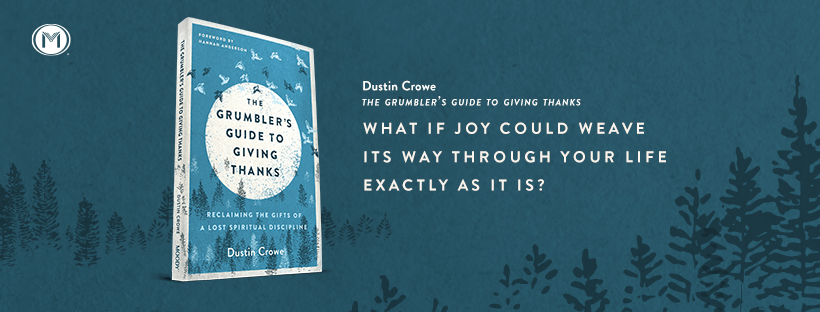
Group Discussion Guide for The Grumbler’s Guide to Giving Thanks

If you picked up a copy of The Grumbler’s Guide to Giving Thanks: Reclaiming the Gifts of A Lost Spiritual Discipline, there’s now a Discussion Guide available. Reading, discussing, and responding to books is always better when done with others than on your own.

You can download the Discussion Guide here.

Continue reading Group Discussion Guide for The Grumbler’s Guide to Giving Thanks

Gratitude Reading Plan (Day 1): Give Thanks to God

(This devotion is day one of a 30-Day Thanksgiving Challenge. Each day includes a daily reading that will be accompanied by a post on this blog.)

Read James 1:17; 1 Corinthians 4:7; Romans 11:36; Matthew 7:9–11

Last November, I browsed dozens of children’s books related to the Thanksgiving holiday, searching for one to teach my daughter about giving thanks. Almost all of them mentioned things to be thankful for but missed the fact that thankfulness has a person on the other end.[1] These books do teach kids to spot stuff they appreciate: their dog, toys, parents, grandparents, teachers, falling leaves, good health, and pumpkin pie. Both kids and adults benefit from considering the blessings in life. But each of these books stopped short.

Continue reading Gratitude Reading Plan (Day 1): Give Thanks to God

Bible Study Questions

We learn by listening, and good listeners ask good questions. While there’s no one-way to do Bible study, one thing we can do is ask questions as we’re reading to help us better observe, interpret, and apply the text. These questions should help us discover the meaning of the passage itself (“what did the author mean?) and move us to living it out? They should not only help us understand the Bible, but they should stir our love for God and neighbor because of what we discover in it.

Continue reading Bible Study Questions

Study Creation to Learn About God

“[Creation] is a speech from God to humanity… The creation, in its entirety, is eloquent; sin is the only dissonance in its song.”  Herman Bavinck

“The universe … is before our eyes like a beautiful book in which all creatures, great and small, are as letters to make us ponder the invisible things of God” Belgic Confession

“Outdoors we are confronted everywhere with wonders; we see that the miraculous is not extraordinary but the common mode of existence.” Wendell Berry

The Psalms are full of references to lessons about God and life in His world that we learn from creation (nature). To be a student of creation makes us learners of the God of creation. To neglect creation is to ignore God’s revelation of Himself.

Continue reading Study Creation to Learn About God

The Broken are the Useful

“Brokenness precedes usefulness.”[1]

Despite our failures, weaknesses, and weariness, despite what was done to us or what we’ve done, and despite hard seasons that feel like we’ve been put in the garage because we’re no longer useful, God uses broken people. In fact, God often walks us through a season of suffering or humility to make us usable.

Continue reading The Broken are the Useful

Gratitude & Thanksgiving Book, Grumbler’s Quiz, and Discussion Guide

My book, The Grumbler’s Guide to Giving Thanks: Reclaiming the Gifts of a Lost Spiritual Discipline, releases today. It’s exciting to see the work become a reality, and I pray that God will use it to stir up gratitude in the hearts of his people.

Maybe you think you’re not really a grumbler, so a book on gratitude isn’t for you. Here’s a Grumbler’s Quiz (excerpted from the book) to help you know if it’s for you or not.

Continue reading Gratitude & Thanksgiving Book, Grumbler’s Quiz, and Discussion Guide

Endorsements for The Grumbler’s Guide to Giving Thanks

I”m excited to announce the release of my new book, The Grumbler’s Guide to Giving Thanks: Reclaiming the Gifts of a Lost Spiritual Discipline. My aim is to help the reader see how pervasive thanksgiving is in the Bible and how practical it is for the Christian life. It’s an everyday rhythm. On a daily basis, our heart gravitates toward either grumbling or gratitude. Each brings with it a host of friends. Grumbling invites pride, fear, anxiety, discontentment, and idolatry. Gratitude is accompanied by joy, worship, contentment, trust, and intimacy with God. Choose to give thanks rather than grumble.

As we give thanks, we not only enjoy God’s gifts to us and care for us, but we better know Him. Thanksgiving, then, is meant to lead us from gifts to the Giver. Even in trials, we practice “gritty gratitude” to trust God and thank Him for how He’s at work.

Below are three of the endorsements for the book.

Continue reading Endorsements for The Grumbler’s Guide to Giving Thanks

Ways to Meditate on Scripture

“If the Word does not dwell with power in us, it will not pass with power from us.” John Owen

Continuing the series of posts on Bible meditation, I wanted to list some practical ideas for how to do it. While meditation can be a result of reflecting on something in creation, life experiences, conversations, our future in eternity, or other things, we’ll focus on meditating on Scripture.

Continue reading Ways to Meditate on Scripture

Resources on Roles & Relationships in Colossians 3:18-4:1

This Sunday, I’ll be preaching on Colossians 3:18-4:1. In a twenty-five minute sermon, you can’t spend adequate time discussing and applying everything mentioned: wives, husbands, children, parents, servants, and masters, not to mention how submission and slavery fit. Below are a few recommended resources for each group as you seek to apply this in everyday life.

Main Idea: Every role and relationship offers an opportunity to follow and reflect Christ. Wherever God has us, we can put on Jesus so he is displayed through our discipleship.

Continue reading Resources on Roles & Relationships in Colossians 3:18-4:1

Recommended Resources from August

I’ve realized how easy it is to consume news, information, and even spiritual knowledge without retaining it. We move from social-media post to online article to amusing YouTube video to online shopping seamlessly. One of the downsides is we don’t reflect on or respond to what we’re reading, viewing, and hearing. Because of the amount of information that inundated us, we also tend to forget what we read (that mattered) and fail to hold on to or prioritize what was actually beneficial.

Continue reading Recommended Resources from August