The OT Backdrop to Jesus’ Good News of the Kingdom

header_kingdom
[This is Part 2 of a series on the Kingdom of God. See Part 1.]

The Backdrop to Jesus’ Good News of the Kingdom
At the very outset of Genesis 1 there is kingdom language for both God (as High King of all) and Adam (as God’s representative king on earth). The language of “image” parallels other Ancient Near Eastern customs when a king would set up his image throughout the kingdom as a representation and reminder of who ruled.[1] God gives Adam a place (kingdom land) and tells him to exercise dominion (kingly rule) and spread (kingdom expansion) throughout the whole earth. Adam and Eve fail to protect the kingdom and even try to stake their claim to God’s throne so they’re exiled from Eden.

Throughout the OT this kingdom theme remains an important part of the storyline.[2] Israel becomes dissatisfied with God alone being their king so they cry out for a physical king to rule over them. This becomes a source of struggle as throughout their history Israel is largely governed by corrupt kings—both from within and without. Along the way, there are sparks of light pointing them to the need for and promise of a great King, a son of David who will rule forever in righteousness and justice, punishing God’s enemies and bringing salvation to His people (2 Sam. 7; Ps. 2, 110). As the OT storyline begins nearing its end (or the beginning), the Prophets voice the ever-increasing rumble of the remnant wanting their King (Is. 11:1; Jer. 33:15; Zech. 6:9-14; 9:9). “The coming of the King…would thus be the focal point of the great deliverance.”[3]

Although the NT phrase of “kingdom of God” isn’t used in the OT it should be clear by now that the ideas were fundamental to Israel’s theology and are a key stream in the Bible’s storyline. Richard Gaffin highlights two dimensions of kingdom in the OT, which parallel two dimensions in the NT. First, there is a “general and eternal kingship”, where God is King over all since He is Creator of all (Ps. 47:2; 103:19; 145:13).[4] Second, there is a “covenantal kingship,” where “God is the king of his covenantal people, Israel” (I Sam. 12:12; Is. 41:21; 43:15).[5] The Jews, therefore, anticipated a coming King who would rescue Israel from exile and reestablish Israel as God’s light to the nations. This Kingdom would bring in the new age and the OT prophets see it as the dawning of a new creation.

Clashing Views of the Kingdom
With this OT history in mind, when Jesus and John the Baptizer speak about the kingdom of God it is not something new and unheard of but something old and hoped for. There wasn’t a birthday party one year where the cousins got together and came up with framing Jesus’ ministry around a clever concept they created, kingdom. “Our Lord did not come to found a new religion, but simply to usher in the fulfillment of something promised long beforehand.”[6] Part of the clash between Jesus and the Jews is what the proper understanding of kingdom is and what it should look like. Jesus brings a kingdom that is not first political but spiritual. The conflicting views on what kingdom should be points us to the reality that first-century Jews had a concept of kingdom, so when Jesus and his followers preached the kingdom of God it is expected that their audience would have OT expectations and categories in their minds. Thomas Schreiner summarizes what those expectations might have been.

“Those hearing Jesus did not ask for a definition of the kingdom. They understood him to be proclaiming the dawn of a glorious new era in which Israel would be exalted and the nations made subservient to Israel’s God. The Lord would reign over the whole earth, the son of David would serve as king, and the exile would be over. The new covenant would be fulfilled, God’s people would keep his law, and the promised new creation would become a reality. The Lord would pour out his Spirit on all flesh, and the promise to Abraham that all nations would be blessed, to the ends of the earth, would become a reality.”[7]

As we move forward in looking into the NT teaching on the Kingdom of God we must remember this backdrop so we don’t think Jesus speaks on the kingdom in a vacuum. The OT anticipates the coming of the King and a Kingdom. The Jews who reject Jesus not only refuse the King but they repudiate his understanding of the kingdom itself. Jesus and the NT authors, however, describe the “mystery” (secret)[8] of the kingdom of God which came to us in Jesus’ life, death, resurrection, and ascension as fulfilling the OT expectations while doing so in a way most Jews might not have expected. This shouldn’t surprise us, since time and time again we see the Jews misunderstanding the fullness of the Scriptures as they replace the agenda of God’s kingdom with their own agenda.

In light of the notion of kingdom being fraught with political, earthly, and material expectations Jesus could have chosen a term less prone to confusion or misunderstood expectations. However, kingdom theology belongs to God and is at the heart of Scripture’s story and Jesus’ identity and mission. It could even be that Jesus also uses the term exactly to undercut and change their misguided assumptions on what they’re waiting for and what God promised in the Scriptures. As we make our way through the pages of the Bible’s story we’re often pleasantly surprised as God’s ways of bringing about his promises goes beyond what we had imagined or expected. So, while OT and Jewish understandings of kingdom are helpful, it is through their Christological fulfillment in the NT that we have greater clarity on its meaning. As John Flavel wrote, “Even so the right knowledge of Jesus Christ, like a clue, leads you through the whole labyrinth of the scriptures.” [9]

Application
In order to keep things brief I won’t be unpacking a lot of direct application as we move forward. However, two immediate applications can be mentioned here for why what’s been written even matters. First, since the kingdom of God is a primary theme in the Bible it will help our understanding of the Scripture, God’s ways, and Christ’s person and work if we better understand the kingdom of God. If we simply choose to ignore the kingdom of God or to allocate it wholly to future things to come then we’ll miss out on our reading of both testaments. Second, this is a good reminder that all of life is lived with the tension of who will be king. God creates us to live under His rule and then to mirror Him to the world. The temptation for man in the Garden of Eden and ever since has been to live under no one’s authority but our own—to crown ourselves as king. Everyone will live with someone as king, and a deeper understand of the kingdom of God under Jesus will help us live faithfully with him and under his gracious rule.

Footnotes:
[1] T. Desmond Alexander, From Eden to New Jerusalem (Grand Rapids: Kregel, 2008), 76-79.
[2] For a good survey of kingdom in the OT, see: Graeme Goldsworthy, Gospel and Kingdom (Crownhill: Paternoster Press, 1981), 58-103; Peter J. Gentry and Stephen J. Wellum, Kingdom through Covenant (Wheaton: Crossway, 2012).
[3] N.T. Wright, The New Testament and the People of God (Minneapolis: Fortress Press, 1992), 320.
[4] Richard B. Gaffin, “Kingdom of God,” in New Dictionary of Theology, ed. by Sinclair B. Ferguson, David F. Wright, and J.I. Packer (Downers Grove: InterVarsity Press, 1988), 367. See NT parallels to this dimension of kingship: I Cor. 15:27; Eph. 1:22; Heb. 2:8.
[5] Ibid., 367. See NT parallels to this dimension of kingship: Mt. 21:5; 28:18; Acts 2:24-36.
[6] Geerhardus Vos, “The Kingdom of God,” in Redemptive History and Biblical Interpretation, ed. by Richard B. Gaffin Jr. (Phillips: P&R Publishing, 1980), 304.
[7] Thomas R. Schreiner, New Testament Theology (Grand Rapids: Baker, 2008), 45.
[8] See Mark 4:11. Geerhardus Vos writes, “This mystery, this new truth, we may find in the revelation that the kingdom is realized gradually, imperceptibly, spiritually, for in comparison with the Jewish exclusively eschatological expectations this was so novel and startling a thought that it might be fitly called a mystery.” Vos, “The Kingdom of God,” 307.
[9] John Flavel, The Fountain of Life in The Works of John Flavel, volume I (Carlisle: Banner of Truth, reprinted 1997), 34.
Kingdom of God Intro: Jesus’ people in his kingdom under his rule

header_kingdom
The Kingdom of Jesus: His Rule, His Place, and His People
“Though we do not have kings in America, or want them, our unconscious mind both has them and wants them. We all know what a true king is, a real king, an ideal king, an archetypal king. He is not a mere politician or soldier. Something in us longs to give him our loyalty and fealty and service and obedience. He is lost but longed for and will some day return, like Arthur.”[1]

The Bible is the story of kings and kingdoms through and through.[2] From Genesis 1 when God commissions his image-bearers to exercise dominion until Revelation 21-22 when Jesus restores a kingdom on the new earth, the whole story smells thick with the aroma of kingdom. And yet, in the opening quote Peter Kreeft pins down an interesting reality that has haunted American evangelical theology.[3] Because we are a people who prize democracy—which means we dislike, dread, or don’t understand kings—American churches have taught very little about “the kingdom of God.” Not that this is the only reason we’ve avoided teaching on the kingdom of God.[4]

The shock of it all is that we haven’t downplayed a theme on the margins of the Bible but one of the primary themes in the NT—and the Bible as a whole. It’s clear that for Jesus, the Kingdom of God was both at the heart of his teaching and his role. John the Baptist prepares the way for Jesus by preaching that the kingdom is nearing (Mt. 3:2). Jesus tells the Jews—who would have heard him with Messianic and Kingly expectations from the OT—that the kingdom is now among them (Lk. 11:20; 17:21). He commissions his disciples before and after the resurrection to preach the good news (gospel) of the kingdom (Lk. 9:2; Acts 1:3). In the Epistles, the exact phrase “kingdom of God” becomes less prominent but the same ideas are retained (Col. 1:13; Heb. 12:18-29). All of that to say, if the Kingdom of God was a priority in Jesus’ teaching and mission, and if it’s at the heart of NT theology, then we should probably make it a priority in our understanding of the NT.

A thorough investigation of kingdom would require tracing its importance and development through every epoch, as well as more in-depth exegesis on a host of NT passages rich with a theology of the kingdom. That can’t be done here—and others have already done it—so I will try to give a fast-break summary of major ideas and descriptions of kingdom in the NT. I will also be arguing for the present (already) aspect of Jesus kingdom being the Davidic kingdom Israel had been looking for. My hope is that by providing a basic framework of the kingdom of God we can begin to take next steps in understanding and then living in light of Christ’s Kingdom we are a part of right now.

A View from the Chopper
Recently I’ve enjoyed doing travel research. I’m a huge fan of history but also like good food, different cultures, and beautiful sights. Researching a location usually begins with the 30,000 foot view. What are the eye-catching zoomed out views of a worthy site (city, landmark, scenery)? How is the place generally described and what gives you a basic feel for the place? It’s similar to a helicopter tour that shows you the city as a whole. But, soon after that, you have to start getting into specifics. What are the specific buildings to see, where is a good hotel, where do I get on a bus? The helicopter view is great in its breadth but walking in the streets is where you really see the depth of a city. This summary will start with the helicopter view and then later on allow us to start navigating the roads and stepping into the must see landmarks when it comes to the kingdom of God. As we take this tour, there will be sites I don’t have the time to point out—not because they aren’t important—so you’ll just have to go back and check them out on your own.

Where We’re Headed
There is much to be said so I will unpack this important idea in 7-8 posts. If you stick with this you will not be an expert on the kingdom of God, but, you will hopefully know a little bit more than when you started. I’ll be honest up front, I’m primarily summarizing a Reformed understanding of the kingdom of God in the NT in its present (already) form, and making a theological defense for why this present kingdom is the promised Davidic kingdom. Here’s a summary of the upcoming posts.

• The OT backdrop on kingdom
• Two misunderstandings on the kingdom
1) Jesus fundamentally understood the kingdom of God promised in the OT differently than the Jews of his day.
2) The kingdom is already present in a real sense and is not wholly future
• The already-not-yet temporal pattern to the kingdom
• How the kingdom of God could be described
1) Working off of Graeme Goldsworthy: God’s people in God’s place under God’s rule
2) Working off of Geerhardus Vos: It’s theocentric, powerful, righteous, and based on God’s graciousness.
• The importance of Ascension to understanding that it is the Davidic Kingdom
• The importance of Pentecost to understanding that it is the Davidic Kingdom
• The Kingdom of God is the eschatological new creation kingdom

Footnotes:
Header image courtesy of the images & graphics Jedi, Greg Pilcher.
[1] Peter Kreeft, The Philosophy of Tolkien (San Francisco: Ignatius Press, 2005), 44.
[2] The word for “kingdom” is used 162 times in the New Testament.
[3] Kreeft does not here make the connection between American democracy and the misunderstanding and downplaying of kingdom from the Bible. In the beginning of the section on Kingdom, Faithmapping does hint at the connection. Daniel Montgomery and Mike Cosper, Faithmapping (Wheaton: Crossway, 2013), 29-30.
[4] Two other reasons could be mentioned. First might be our need for proof texts where the word “kingdom” is used rather than being able to make connections with thematic allusions like “throne,” “reign,” “David’s Son,” and others. Second, the prominence of dispensational theology in much of America, which until the last 20 years saw the kingdom of God as almost entirely future, minimized preaching and teaching on the kingdom of God.

Jesus, the Davidic King

bock
“Being therefore a prophet, and knowing that God had sworn with an oath to him that he would set one of his descendants on his throne, he foresaw and spoke about the resurrection of the Christ, that he was not abandoned to Hades, nor did his flesh see corruption. This Jesus God raised up, and of that we all are witnesses. Being therefore exalted at the right hand of God, and having received from the Father the promise of the Holy Spirit, he has poured out this that you yourselves are seeing and hearing. For David did not ascend into the heavens, but he himself says,‘The Lord said to my Lord, “Sit at my right hand, until I make your enemies your footstool.”’” (Acts 2:30-35)

It’s hard for me to believe that Dispensationalists would claim that Jesus is not the Davidic King reigning right now on the Davidic throne over the eternal Kingdom of God promised to David’s Son. That view has however become a minority as classical and revised dispensationalists are either on or nearing the theological endangered-species list (at least in academic and biblical-theology circles). Among the numerous responses that I’ve found helpful, here are some quotes from Progressive Dispensationalism (which on a spectrum is closer to Covenant Theology than Dispensational Theology) by Craig Blaising and Darrell Bock.

Craig Blaising and Darrell Bock bring up three of the most common classical or revised dispensational objections to Jesus’ reign as Davidic King. I’ll mention the first two and quickly summarize their response (although I recommend reading this section in their book in its entirety).

In sum: “Beginning in Acts 2, Jesus’ apostles began to preach that His resurrection was the fulfillment of the covenant promise to ‘raise up’ David’s descendant. The promise to raise up a descendant, in 2 Samuel 7:12, is connected with the promise to establish His kingdom or, putting it another way, to establish His throne. Peter argues in Acts 2:22-36 that David predicted in Psalm 16 that this descendant would be raised up from the dead, incorruptible, and in this way, He would be seated upon His throne (Acts 2:30-31). He then argues that this enthronement has taken place upon the entrance of Jesus into heaven, in keeping with the language of Psalm 110:1 that describes the seating of David’s son at God’s right hand.” (p. 177)

Objection 1. “The throne Jesus received at His ascension was not the throne promised to David.”.
“First of all, the objection fails to observe the fact that every New Testament description of the present throne of Jesus is drawn from Davidic covenant promises….In Acts 2:30-36, the resurrection, ascension, and seating of Christ in heaven at the right hand of God (Ps. 110:1) are presented in light of the prediction ‘that God had sworn to him [David] with an oath to seat one of his descendants upon his throne’ (Acts 2:30). No other throne is discussed in this text except the Davidic throne.” (p. 182)

“The second problem with the objection is that it fails to comprehend the relationship between God’s heavenly rule over Israel and the rule of His chosen king….Because of the covenant orientation of the heavenly throne to Israel, Jesus’ enthronement there makes Him the Christ, the anointed king of Israel. And because God, the King of Israel, had covenanted to David that his descendant would rule Israel and all the nations, this installation of Jesus (the son of David whom God has raised up from the dead) in heaven by the divine King of Israel portends an imminent descent to the Jerusalem throne.” (pp. 184-85)

Objection 2. “Jesus’ present activity is best understood as divine sovereignty, not Davidic kingship.”
“First of all, we note that the Bible explains Jesus’ present activity in Davidic as well as divine terms….Repeatedly through the Book of Acts and the Epistles, it is as the Christ (that is Messiah, the anointed Davidic king of Israel), seated at the right hand of God (the Davidic position) that He is active today.” (p. 185)

Craig A. Blaising and Darrell L. Bock, Progressive Dispensationalism (Grand Rapids: Baker, 1993), 174-283. Pages 182-187 are worth reading in their entirety.

Links to articles

A few people have asked where they could find the articles I wrote a couple of weeks ago so I thought I’d link them here.

Here is a link to my article “What Does It Mean to “Remember” in the Lord’s Supper?” from The Gospel Coalition.

And, here is a link to my article “8 Characteristics of Gospel-Centered Sanctification” from Gospel-Centered Discipleship.

I recently did a radio interview with Pilgrim Radio about my article on sanctification. Their radio stations are out West so anyone local interested in listening would have to stream it as it’s being played. It’s airing tomorrow (Thursday) at 5:30AM and 3:30 PM and then 12:30 AM Friday morning (Thursday night).

Don’t Confuse or Divide Indicative & Imperative

r6
“For sin will have no dominion over you, since you are not under law but under grace.” Romans 6:14

More often than not when somebody throws out the “we’re not under law but under grace” phrase it’s either used to say, “Hey, come on! I’m a Christian so my sin’s not all that big of a deal,” or “Don’t give me any commands. That’s old-school, like Moses and the Old Testament era old-school.”

In light of this, we might forget that the phrase is actually tied to an exhortation for holiness, “sin will have no dominion over you.” That statement is both a fact based upon our dying and being raised in Jesus (Romans 6:1-13) as well as a reminder of what reality should look like in light of that fact: we shouldn’t let ourselves live under sin’s dominion (Rom. 6:15-23).

As someone who wants to daily find refreshment in free grace while also wanting to mature in Christ in a manner propelled by that grace, I find Romans 6:14 to be a huge help. It gives me an encouragement to pursue holiness without making either my energy in that pursuit or how far I make it in that pursuit the source of my confidence before God. Douglas Moo provides a helpful explanation as to why the indicative and imperative should neither be confused nor separated.

“‘Indicative’ and ‘imperative’ must be neither divided nor confused. If divided, with ‘justification’ and ‘sanctification’ put into separate compartments, we can forget that true holiness of life comes only as the outworking and realization of the life of Christ in us. This leads to a ‘moralism’ or ‘legalism’ in which the believer ‘goes it on his own,’ thinking that holiness will be attained through sheer effort, or ever more elaborate programs, or ever-increasing numbers of rules. But if indicative and imperative are confused, with ‘justification’ and ‘sanctification’ collapsed together into one, we can neglect the fact that the outworking of the life of Christ is made our responsibility. This neglect leads to an unconcern with holiness of life, or to a ‘God-does-it-all’ attitude in which the believer thinks to become holy through a kind of spiritual osmosis. Paul makes it clear, by the sequence in his paragraph, that we can live a holy life as we appropriate the benefits of our union with Christ. But he also makes it clear, because there is a sequence, that living the holy life is distinct from (but not separate from) what we have attained by our union with Christ and that holiness of life can be stifled if we fail continually to appropriate and put to work the new life God has given us. Jeremiah Bourroughs, a seventeenth-century Puritan, put it like this: ‘…from him [Christ] as from a fountain, sanctification flows into the souls of the Saints: their sanctification comes not so much from their struggling, and endeavors, and vows, and resolutions, as it comes to them from their union with him.'”[1]

[1] Douglas Moo, The Epistle to the Romans (Grand Rapids: Eerdmans, 1996), 391.

Remember Remember

In the movie V for Vendetta, the masked man frequently speaks these key words: “remember, remember.” Referencing Guy Fawkes and the failed Gunpowder Plot on November 5, 1605, the character known only as V quotes the famous poem: “Remember remember, the fifth of November…” Throughout the movie, the call to remember is a call to action. V is not merely interested in history for history’s sake (though he recognizes history’s importance and power), but he sees it as a catalyst for the past speaking into the present.

Continue reading Remember Remember

Stephen Charnock on God’s Eternality & Immutability: It Matters

CharnockI get it. Thinking about the attributes of God can be tough work, but it is work with a payoff. As our minds do the heavy lifting our hearts reap the benefits of bigger affections. We often think of God in small, bland, and largely insignificant terms. We bring God to our level as we construct our view of him by tiny, often misguided thoughts. Thinking biblically—i.e., theologically—quickly leads to our view of God being shattered as we see him getting larger and larger in immensity, glory, and holiness.

Thinking through God’s attributes also helps us know how God relates to us. A firmer grasp on who God is directly relates to who God is for me. Most of God’s self-revelation in Scripture is relational, or covenantal. God explains himself in the context of how he relates to his creation, especially his own people. The fact that God reveals himself not primarily in philosophical or scientific terms but in relational terms should convince us he wants our theology about him to directly influence our relationship with him.[1}

I’ve started slowly reading A Puritan Theology: Doctrine for Life.[2] Is there any other way to read the Puritans than slowly? Chapter 4 concentrates on Stephen Charnock’s (1628-1680) Discourses upon the Existence and Attributes of God. Charnock, like any good theologian, doesn’t talk about God’s attributes in isolation from each other as if sometimes God is more of one attribute than the other. Instead, God is all of his attributes to their fullest extent at once. Furthermore, these attributes are actually God’s essence. God isn’t simply loving, but he is love. “For though we conceive the essence of God as the subject, and the attributes of God as faculties and qualities in that subject, according to our weak model…yet truly and really there is no distinction between his essence and attributes; one is inseparable from the other. His power and wisdom are is his essence.”[3]

God’s eternity teaches that there never was a time when he was not. There is no beginning or end to God. “His duration is as endless as his essence is boundless.”[4] Here is one description Charnock provides.

“[God] is not in his essence this day what he was not before, or will be the next day and year what he is not now. All his perfections are most perfect in him every moment; before all ages, after all ages. As he hath his whole essence undivided in every place, as well as in an immense space; so he hath all his being in one moment of time, as well as in infinite intervals of time….He is what he always was, and he is what he always will be.” [5]

As the quote indicates, there is a clear synthesis between God’s eternality and God’s immutability. God always has and will exist (eternal) and he always has and will exist in the fullness of his perfections (immutable). There is no change in God because he eternally exists as the whole essence of all his perfections which are “most perfect in him every moment.” Beeke and Jones quote Charnock to explain how these two attributes of God relate. “Immutability in God is a ‘glory belonging to all the attributes of God.’ God has attributes and perfections that are different, but ‘immutability is the center wherein they all unite.’ What God is, He is eternally and unchangeably.”[6]

Doctrine for Life
Let’s briefly consider how God’s eternality and immutability are what the subtitle of the book suggests, doctrine for life. If God is all of his perfections perfectly—all the time—then I never have to pit his attributes against one another. Nor should I worry if at any given moment he is acting out one of his attributes more than the other. Because every person I know is the opposite of this, unless I intentionally remind myself God is not like us I will think of him in finite and false terms. For example, how I treat you might depend on not only the day but the moment you run into me. If I had some great coffee and an easy drive into work, then I’ll probably be in a good mood and so I’ll act with more grace and patience than normal. However, if my morning gets off to a rough start or the day goes south quickly, then you’re more likely to get the impatient and graceless me.

When I’m not thinking rightly about God I start believing his relationship with me and how he treats me must be similar. Maybe God’s had enough of my failings and is tired of me not getting it—and so I imagine I’m in danger of God deciding to give up or lash out on me. When trials or seemingly avoidable pains are placed on my path I can quickly conclude God is not as good or caring as he used to be. Our faith operates from our theology, and unfortunately our theology often starts to err as it’s built upon false thoughts from our own minds instead of truthful thoughts from the mouth of God (Bible). This is why theology is vital for all Christians. We study the Bible so we can know God better and more rightly.

The truth is it takes work on our part to think of God rightly and not piece together a view of God based upon how fallen people act and upon my own thinking and assumptions. Studying God’s eternality and immutability does me good because it reminds me God is not like me or anyone else I’ve come across. He doesn’t relate to me according to up and down moods he’s in but according to his unchanging and perfect character. If he is perfect in all his attributes and is them perfectly all the time, then I can trust he always deals with me according to his goodness, care, and love. In the midst of either frustratingly confusing circumstances or unbearable pain I might not have answers as to the why but I know the Who. During seasons of life where things seem trivial, or where “darkness hides his lovely face,” or even when our hearts are bursting with gratitude, I can know that God has not changed and he is not being anything other than the fullness of God. As James tells us, there is no variation or shifting shadows in God (James 1:17). In you and I, yes; but not in God. That type of theology not only evokes adoration in the moment but it sustains us for a lifetime.

For Christians who tend to shrink because of weak hearts, doubting minds, troubling fears, or soft consciences, we would do well to commit ourselves to studying God’s attributes—especially his love, grace, compassion, and care. As we start to grow in our theology of what God is really like it becomes an immense encouragement to know he is all those attributes all of the time to their fullest extent. God is always all of his perfect perfections.

Footnotes
[1]. This of course isn’t to suggest God’s self-revelation doesn’t involve philosophy or science, and it certainly doesn’t suggest God is not accurate in his revelation. It simply conveys that God’s revelation comes in the context of relationship. He reveals Himself as Maker, Sovereign, and Redeemer.
[2]. Joel R. Beeke and Mark Jones, A Puritan Theology: Doctrine for Life (Grand Rapids: Reformation Heritage Books, 2012).
[3]. Stephen Charnock, Discourses upon the Existence and Attributes of God (London: Thomas Tegg, 1840), 242. Found in A Puritan Theology, 65.
[4]. Charnock, Existence and Attributes, 175-76. Found in A Puritan Theology, 63.
[5]. Charnock, Existence and Attributes, 178. Found in A Puritan Theology, 63
[6]. A Puritan Theology, 64. Emphasis mine.

Three Creeds Every Christian Should Know

creed
This morning our church recited the Apostles Creed. There are at least two reasons why I’m glad we do this. First, the Apostles creed is accepted by the Roman Catholic, Orthodox, and Protestant churches so it has been affirmed by Christians for over 1600 years (at least). Second, it’s the most simple of all creeds and formed the base of later creeds, such as the Nicene creed. It’s simplicity is both its weakness and its strength. Later creeds would expand upon the Apostolic creed, but they would not deny anything it contained. The church fathers named heresies because they believed a heresy was  a departure of the Christian gospel, and where the gospel was distorted or lost the Christian faith was distorted or lost. We would be well served by regularly reading and reciting these three creeds, both for our doctrinal orthodoxy and for right worship of our Triune God.

The Apostles Creed
I believe in God the Father Almighty
[Maker of heaven and earth;
And in Jesus Christ, his only Son, our Lord; Who was conceived by the Holy Ghost, born of the Virgin Mary; Suffered under Pontius Pilate, was crucified, dead and buried;
[He descended into hell (Hades)]
The third day he rose from the dead; He ascended into heaven; and sits on the right hand of God the Father Almighty; From thence he shall come to judge the quick and the dead.
I believe in the Holy Ghost; the holy catholic Church; [the communion of saints]; the forgiveness of sins; the resurrection of the body; [and the life everlasting]. Amen

The clauses in italics are those not included in the “Old Roman Creed” from around 340, but was included in the final accepted version. Compare this to the Nicene Creed (381 version), which simply amplifies the Apostles Creed.

The Nicene-Constantinopolitan Creed
We believe in one God, the Father Almighty, Maker of heaven and earth, and of all things visible and invisible;
And in one Lord Jesus Christ, the Son of God, the Only-begotten, Begotten of the Father before all ages, Light of Light, Very God of Very God, Begotten, not made; of one essence with the Father, by whom all things were made:
Who for us men and for our salvation came down from heaven, and was incarnate of the Holy Spirit and the Virgin Mary, and was made man;
And was crucified also for us under Pontius Pilate, and suffered and was buried;
And the third day He rose again, according to the Scriptures;
And ascended into heaven, and sits at the right hand of the Father;
And He shall come again with glory to judge the living and the dead, Whose kingdom shall have no end.
And we believe in the Holy Spirit, the Lord, and Giver of Life, Who proceeds from the Father, Who with the Father and the Son together is worshipped and glorified, Who spoke by the Prophets;
And we believe in one, holy, catholic, and apostolic Church.
We acknowledge one Baptism for the remission of sins.
We look for the Resurrection of the dead,
And the Life of the age to come. Amen.

Whereas the Apostles creed summarized the most basic beliefs of the early Christian faith, the Nicene creed took a stance on upholding the deity of Christ and the Triune God. The Chalcedonian Creed (451) outlines the orthodox view of the two natures of Jesus Christ.

The Chalcedonian Creed

We, then, following the holy Fathers, all with one consent, teach men to confess one and the same Son, our Lord Jesus Christ, the same perfect in Godhead and also perfect in manhood; truly God and truly man, of a reasonable [rational] soul and body; consubstantial [co-essential] with the Father according to the Godhead, and consubstantial with us according to the Manhood; in all things like unto us, without sin; begotten before all ages of the Father according to the Godhead, and in these latter days, for us and for our salvation, born of the Virgin Mary, the Mother of God, according to the Manhood; one and the same Christ, Son, Lord, only begotten, to be acknowledged in two natures, inconfusedly, unchangeably, indivisibly, inseparably; the distinction of natures being by no means taken away by the union, but rather the property of each nature being preserved, and concurring in one Person and one Subsistence, not parted or divided into two persons, but one and the same Son, and only begotten, God the Word, the Lord Jesus Christ; as the prophets from the beginning [have declared] concerning Him, and the Lord Jesus Christ Himself has taught us, and the Creed of the holy Fathers has handed down to us.

I’ve not read any of the articles but I feel comfortable recommending The Resurgence’s series on The Concise History of Creeds & Confessions to learn more.

There’s Something About Mary…the mother of Jesus

20130914-160552.jpg
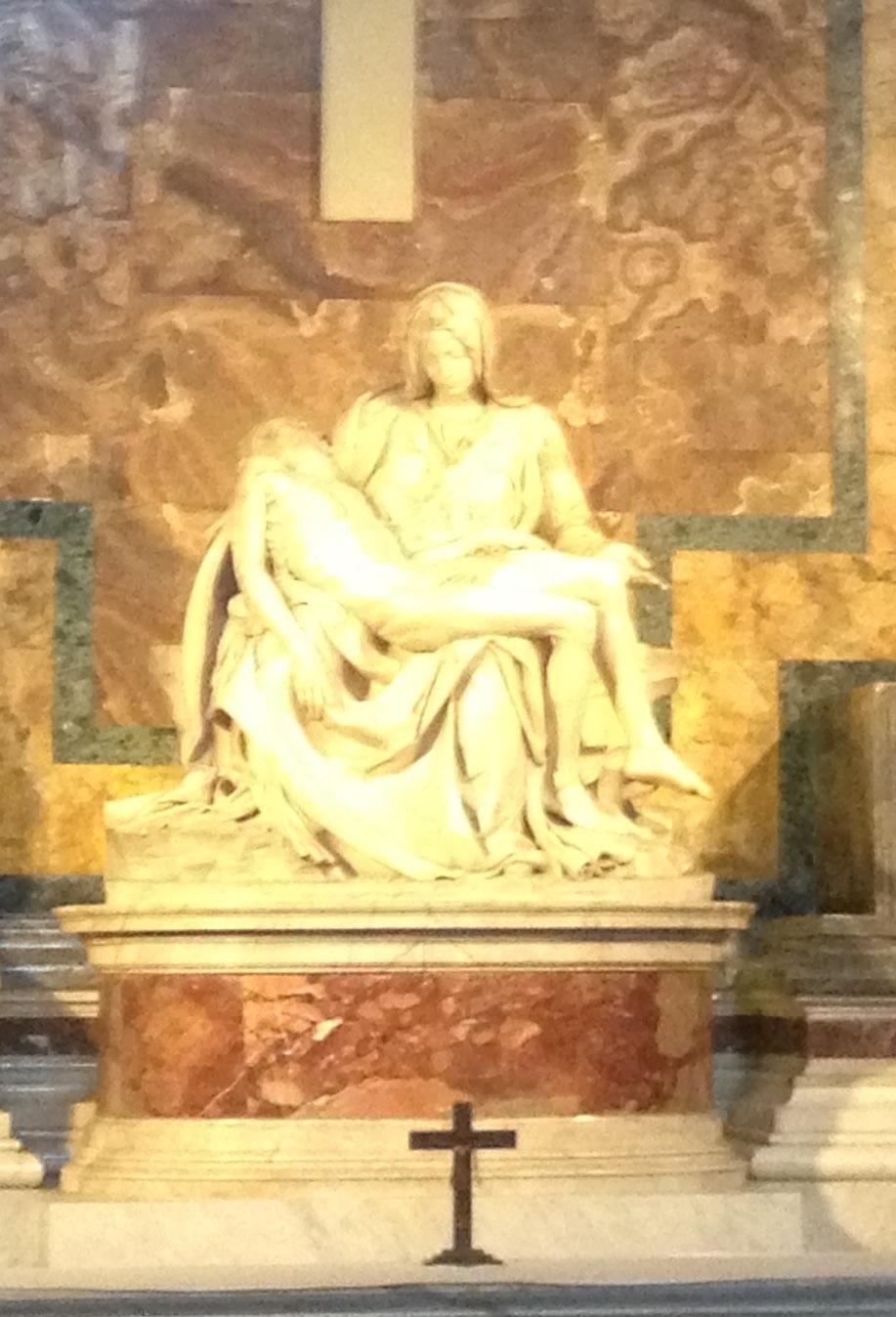
In my recent trip to Europe (hence the grainy pic above) where I visited several beautiful, historic Catholic churches there were several questions that came to mind. As a Protestant, one of them was why the big deal about Mary? My Catholic tour guide (he was fantastic) paralleled the current Pope to Michelangelo in their preference to pray to Mary over Jesus. I’ve heard that before but it still always strikes me as curious. Why the need to make Mary more than the biblical authors do and when did it all start?

Of course, to be a bit simplistic, I think part of the problem clearly lies in the fact that most people were illiterate in the church’s history, and the Bible was, unfortunately, kept away from the eyes and ears of the people. However, I still found something intriguing and wondered if any Catholics who once belonged to these ancient churches ever asked why Mary wasn’t in the story pictures. By story pictures, I’m referring to those paintings (usually on ceilings) that were meant to tell biblical stories–often the overarching biblical story–to people who couldn’t read and wouldn’t have Bibles even if they could read. What I noticed is that in these paintings of biblical stories (meaning stories actually based on the texts) is that other than the birth of Christ, Mary remains noticeably absent from the other paintings. Wouldn’t anyone in the church ever have wondered why Mary was being elevated when she’s clearly absent from the paintings retelling the biblical story? Yes, there were many paintings and statutes of Mary throughout the churches I went too, but these weren’t part of the paintings retelling the biblical story. I find this fascinating. My hope isn’t to offend Catholics but to really understand more of the history behind mariology.

After returning home, I was given the chance to read a bit of early church history in preparation of teaching a session at our church. Since I don’t do well with letting things go I thought I’d do a tiny bit of digging as to when references to Mary developed as something more than just the virgin mother of Jesus. I’m just scratching the surface on this and related issues so I’d appreciate any feedback or sources.

I’ve been reading a bit of Irenaeus since my talk focuses on the rise of bishops and why apostolic succession was so important for the church’s unity. Irenaeus was the first guy I came across who talks about Mary in detail, although I later found that he probably was reiterating what he read in Justin Martyr’s Dialogue With Trypho the Jew. [Note: Although Justin Martyr parallels Mary with Eve he seems to focus on what both of them conceived, not their merit or actions.] It seems like (from my limited reading) Mary was referenced early as the church combatted Gnosticism. Most forms of Gnosticism denied the genuine humanity of Jesus, so Mary the mother of Jesus was used to defend the humanity of Jesus. It seems this quickly progressed into something more. This is a good time to stop and remember that the earliest theologians (2nd-3rd century AD) were still grappling both with who Jesus was and what salvation actually meant. Unfortunately, many of these early church fathers had a theology of salvation or atonement that was quite under-baked. Once persecution settles down and Athanasius enters the scene we’re provided with a much more robust theology. Back to Irenaeus, who is known for how he sees the NT recapitulating the OT. In his Demonstration of Apostolic Preaching, he takes the biblical parallel between Adam and Jesus as the 2nd Adam (cf. Rom 6 & I Cor. 15) and stretches it so that Mary parallels Eve. Here’s one quote (thank you Google Books):
“And just as through a disobedient virgin[,] man was stricken down and fell into death, so through the Virgin who was obedient to the Word of Go man was reanimated and received life….For it was necessary that Adam should be summed up in Christ, that mortality might be swallowed up and overwhelmed by immortality; and Eve summed up in Mary, that a virgin should be a virgin’s intercessor, and by a virgin’s obedience undo and put away the disobedience of a virgin.” (Dem 33)

After this, other patristic theologians wrote similar things (Tertullian, Ambrose, Jerome) and it seems like Mary’s role and importance grew at different times in later history. Then, in the 19th and 20th century we can see how Roman Catholic dogma had progressed to not just seeing Mary as playing an important role in bringing Life through Jesus, but to actually playing a part in redemption with Jesus. In 1854, Pope Pius IX put into dogma via papal bull the doctrine of Immaculate Conception, stating that Mary was conceived without original sin. Then, in an Encyclical from Pope Pius XII in 1954, he states the following (there are several similar statements): “39. Certainly, in the full and strict meaning of the term, only Jesus Christ, the God-Man, is King; but Mary, too, as Mother of the divine Christ, as His associate in the redemption, in his struggle with His enemies and His final victory over them, has a share, though in a limited and analogous way, in His royal dignity.”

I was more interested in the historical factor of where an interest in Mary came from (and still am since this is only one factor among many). As a bible-thumping Protestant, I strongly uphold our redemption in the 2nd Adam, and since Mary is never mentioned or hinted at in regards to our salvation or paralleled as a 2nd Eve I strongly disagree with Roman Catholic theology in this regards. Not only is it a big stretch to making Mary a 2nd Eve because Jesus is a 2nd Adam, but it also seems to be a big stretch even to get from the quotes of the early church fathers on Mary being significant (because she conceived Jesus and therefore conceived life) to the later Roman Catholic teaching that she is an associate in our redemption.