Philippians and Richard Baxter

Baxter
This week my church begins preaching through the book of Philippians for the rest of the summer. The opening section gives a glimpse into the heart of Paul for the believers in Philippi. While the beginning of Philippians shows us more of the Apostle Paul it also shows us what hearts united in the gospel feel for one another. The love for Jesus and “partnership in the gospel” (Phil. 1:5) lead to holding one another in our hearts (1:7) and yearning for one another with the affection of Christ Jesus (1:9). As I read Geoffrey Nuttall’s The Holy Spirit in Puritan Faith and Experience I stumbled upon a letter from Richard Baxter. This short snippet from Baxter’s letter (1658) to Barbara Lambe demonstrates how Baxter, maybe the most pastoral of Puritan pastors, also shared a love for other believers he never met that is created by a mutual partnership in the gospel and common bond in Jesus Christ. After Baxter received a letter from Mrs. Lambe he responded with the following.

“Dear Mrs. Lambe,
How true did I feel it in the reading of your Husband’s Lines and yours…that unacquaintedness with the face is no hindrance to the Communion of the Saints. So much of Christ and his Spirit appeared to me in both your writings, that my soul in the reading of them was drawn out into as strong a stream of love, and closing unity of Spirit, as almost ever I felt in my life. There is a connaturality [relationship created because of the same origin] of Spirit in the Saints that will work by sympathy, and by closing uniting inclinations…as a load-stone will exercise its attractive force through a stone wall. I have an inward sense in my soul, that told me so feelingly in the reading of your lines, that your husband and you and I are one in our dear Lord…”
[1]

[1] Geoffrey F. Nuttall, The Holy Spirit in Puritan Faith and Experience (Chicago: University of Chicago Press, 1947), 143.

Preaching the Gospel to Ourselves?

preach
Should We Preach the Gospel to Ourselves?
Recently I had a good conversation with one of our church’s pastors about the idea of preaching the gospel to ourselves. It has become a popular manta, especially in the “gospel-centered” camps. But, for those of us who upheld the importance of preaching the gospel to ourselves (and one another), have we faced a couple of questions now being raised? First, does the NT commend something along the lines of preaching the gospel to yourself? Or, is that idea (not just the language) somewhat foreign to the NT? Second, if the NT does commend something similar to this concept, why is it worth emphasizing in our day and age? And third, when it comes to sanctification, is preaching the gospel to ourselves enough, or do we move past this initial step as we move into obeying God’s commands, working out our salvation, putting off and putting on, etc.? More questions like this need to be raised so that we’re thinking about our thinking. It’s all too easy to latch onto things that feel right, like being “gospel-centered” or “preaching the gospel to ourselves,” without asking questions about its importance, its meaning, and its effects. I’ll try to tackle each of those questions briefly.

Does the NT commend something similar to preaching the gospel to ourselves?
The language is not explicitly in the NT. On one side, this might give caution to over-estimating an extra-biblical idea. On the other side, specific language doesn’t have to be used in the Bible in order to hold good and necessary conclusions and consequences based on that language. Extra-biblical language can be very helpful in defining what we actually mean. The best example is the Trinity. The wording isn’t used, but the idea of their being one God, three persons, and each person being fully God is clear. So, while the language of “preaching the gospel to ourselves” isn’t in the Bible, I believe the idea behind it can still be found.

Our first model of preaching the gospel to ourselves is Paul’s example. In every NT letter Paul preaches the gospel to believers. He reminds and explains the gospel to them as the basis of why they both can and should make every effort to mature in holiness. He takes them back to the historical work of Jesus (according to the Scripture) and how it is for them (the message).
o Each letter begins either with an opening reminder of the gospel (Eph. 1:3-14; I Cor. 1:30) or the letter has a structure of preaching the gospel first before encouraging them to then live in light of it (See Rom. 1-8, 12-15; Eph. 1-3,  4-6).
o The fact that the NT letters are so full with explicit and implicit gospel-preaching to believers must mean the gospel needs to be remembered and rehearsed so that we know what we should do (ought) and that we really can do it now (can).
o Paul desires to preach the gospel to believers and churches he writes too (cf. Rom. 1:15; Phil. 3:1), not because they don’t know it already but because it must be massaged into our stubborn skulls.

Paul seems to urge Titus to exhort and rebuke the church in “these things” (3:15), which includes both the message of redemption and purification in Jesus (3:14) and the need to renounce ungodliness. See also the emphasis in 3:8 to insist on “these things, so that those who have believed in God may be careful to devote themselves to good works.” What are these things? Well it likely includes both the message of justification and renewal in Jesus (3:4-7) and the encouragements in Christ-likeness (3:1-3).

In Ephesians 4:15 Paul exhorts the church to speak the truth in love to one another as the means to mature in Christ. The truth we speak to one another (i.e., preach to one another) is primarily the gospel message about Christ’s person, work, and what we receive through him. This verse reminds us that we not only preach the gospel to ourselves as we meditate on its truth privately, but we preach the gospel to one another as we speak the truth in community. Here are two quotes drawing out what “truth” might mean here.
o “In this context, however, it conveys the more specific sense of accepting the truth of the gospel, speaking it out loud in the corporate gatherings of worship, talking about it with fellow believers, and upholding it firmly.”[1]
o “Accordingly, the apostle is not exhorting his readers to truthfulness in general or speaking honestly with one another, however appropriate or important this may be. Rather, he wants all of them to be members of a ‘confessing’ church, with the content of their testimony to be ‘the word of truth,’ the gospel of their salvation (1:13).’”[2]

Why Preaching the Gospel to Ourselves is Especially Important Today
If you agree with my conclusions above that the Bible supports the idea (or at least something close) of preaching the gospel to ourselves and one another, than the biblical justification is the best justification we have for doing so. However, I think it is especially needed in our current evangelical climate to preach the gospel regularly for at least these reasons. It’s not that this is only thing to preach to ourselves, and it’s certainly not that we only preach the gospel to ourselves, but as we move on to working out our sanctification in our daily lives we must do so with the gospel as our fundamental reason and motivation.

o We need to live daily with a reminder of our sinfulness and our corrupted nature from birth so as not to become prideful or self-reliant. And yet, the knowledge of sin that brings repentance is the same knowledge that leads us to find grace, forgiveness, assurance, and help through Jesus in the gospel. We must remember both who we were/are on our own, but even more so, who we are now in Jesus. The former keeps us humble and grateful and the latter reminds us we really are forgiven, loved, and equipped.
o We need this daily reminder because many see God as someone who will save them but doesn’t really like them unless they do all the right things. Many see God through the lens of how human relationships: recompense. We preach the gospel of free grace to remember God is not like us.
o We need this daily reminder because we’re performance-driven and self-reliant so we will assume we can mature in holiness by our own strength and we’ll then take the credit. The gospel puts us on our knees in brokenness, but it doesn’t leave us there. It picks us up off the floor so we can by God’s grace alone press on.
o We need this daily reminder because many are burnt out because all they’re told they should be doing as a Christian and they know how little progress is taking place. Our culture of busyness and accomplishment makes the Christian life feel like a fast-moving treadmill that runs them into the ground without taking them anywhere. The gospel leads to a life of risk and mission, but it doesn’t do it at the cost of our resting in Christ and relying on the Spirit to do the work through us.
o We need this daily reminder because we continually sin. Our ongoing sins require us to preach the gospel to ourselves (and others in community) to remind us of repentance, faith in Christ’s work, and the promise for help as we continue to press on. The gospel only needs to be preached as often as we still struggle with sin, but since that struggle leads to daily wounds we also need to daily apply the healing salve of the gospel.
o We need this daily reminder because we forget. We forget both what God has actually done for us and who we are now as a new creature in him. Our memory quite easily recalls our sin and is well tuned to hear the voices of others pointing out our failures. So, we preach the gospel of grace because its foreignness and our forgetfulness require a constant reminder of what God has said is true. This is why Paul is okay with reminders (Phil. 3:1) and repetition of the gospel even to believers (Rom. 1:15).

Is Preaching the Gospel to Myself All I Do?
We first looked at some biblical support for preaching the gospel to ourselves and one another. Then, we looked at a few reasons why we need to regularly be preaching the gospel to ourselves. We now come to two other related questions. Is preaching the gospel to ourselves the only motivation for sanctification? And second, is sanctification only a matter of preaching the gospel to ourselves? Or, in other words, if I simply preach the gospel to myself have I done all I need to do, and if I preach the gospel to others in community have I told them all they should know in order to mature in Christ-likeness? I think the answer to these questions is no.

First, the Bible includes a number of motivations for Christians to help energize their sanctification, including: gratitude, new ownership, promise of blessings and greater joy, hope of reward, assurance, duty, Jesus’ glory, fear of God, love to God and neighbor, etc. We should seek knowing more of these motivations and letting all of them increase our desires for following Jesus. One of the dangers of among some today is limiting our motivation to only our gratitude or freedom in justification. No doubt, that is a glorious truth that ignites our passion to follow Jesus, but it’s not the only one and so we should be careful to not speak as if it is.

Second, preaching the gospel to ourselves is neither the end-goal or sufficient when it comes to our sanctification. The gospel in the NT is preaching to unbelievers to bring them to saving faith Christ (generally speaking), while in the NT it’s most often preached to believers with the end-goal of them growing in Christ and loving him more. The gospel is our treasure and through Christ alone we’re justified, but the gospel is meant to lead Christians into holiness and mission. We should hold strongly to preaching the gospel to ourselves, but we also must not minimize or neglect the many imperatives in Scripture and the life we are called to live in Jesus. This life of sanctification is itself grace, both because we can finally do it through the power of the Holy Spirit and because we can do it as grateful sons and daughters of God rather than slaves trying to earn their keep. As we take further steps in maturing we aren’t moving past the gospel in the sense of letting it go, but we’re moving on in the sense that the gospel pushes us into something else. The gospel we preach to ourselves is the catalytic gospel propelling us into obedient and fruitful lives. The growing trend of fearing the imperatives in Scriptures, wrongly equating rules with legalism, and stopping at preaching the gospel to ourselves is a serious error that conveys a half-truth about grace and life in Christ.

Preaching the gospel to ourselves comes up short if it only reminds us of our justification in Christ without also nudging us towards the grace of progressive sanctification by the Spirit. The gospel not only holds out the promise of no condemnation but it promises us that God will write the law on our hearts, change our hearts, and leads us by His Spirit into a new way of living. We must preach the gospel to ourselves, including the realities of who we are and what we’ve received in Jesus Christ as well as the life of following Jesus we’re called to walk and his provisions for us walking it. The NT repeatedly tells us what we should do (imperative/ought) but always roots it in why we can do it (indicative/can). We must continually preach the gospel to ourselves so we do strive to grow but do so in light of God’s gracious working and power enabling us. This means we also should not shy away from emphasizing how we should live in Christ and the need for obedience and holiness. Grace properly understood gives the type of internal rest that energizes us to get to work.

Footnotes:
Image via Acts29 post.
[1] Clinton E. Arnold, Ephesians ECNT (Grand Rapids: Zondervan, 2010), 269.
[2] Peter T. O’Brien, The Letter to the Ephesians (Grand Rapids: Eerdmans, 1999), 311.

Lent: History, Cautions, and Benefits

For those groups—and there are a lot of them in Catholicism, Orthodoxy, and Protestantism—that hold to a liturgical calendar and its celebrated seasons and days, Lent begins the pilgrimage to Jesus’ cross and resurrection. For most in the West, the season begins with Ash Wednesday and takes place over the next 40 days (Sundays excluded). Can Lent be abused or misused? Yes, of course. Can Lent be observed in a helpful way? I think so. It’s certainly not prescribed in the Bible so we shouldn’t see it as a God-ordained means of grace or as required for Christians, but at the same time, if done in the right way it might be a helpful teaching opportunity that prepares our hearts to feast on the Bread of Life, Jesus. Here’s a very brief explanation as to what Lent is, what is dangerous about it, and what might be helpful about it.

Continue reading Lent: History, Cautions, and Benefits

Another Great Civil War Quote

emancipationday
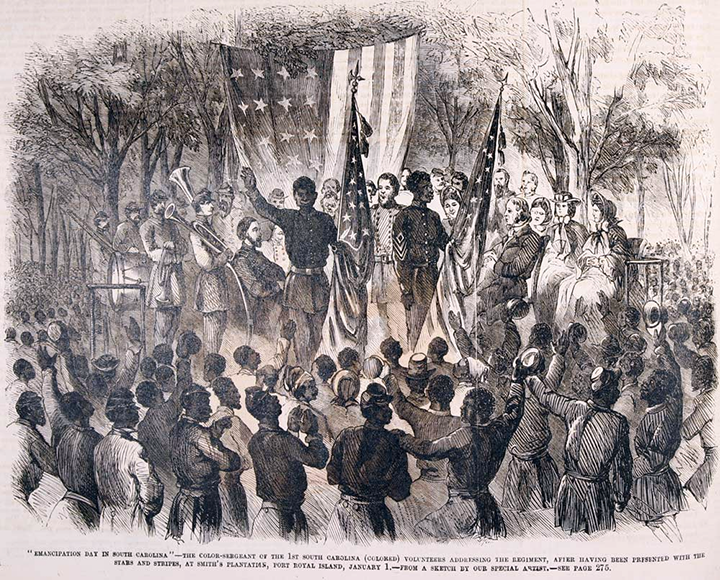
Last week I posted a beautiful quote written by Frederick Douglass where he captures what it was like for a slave to see ships of free men sailing in and out of port each day. Here is another great entry from the Civil War. Thomas Wentworth Higginson was Colonel of the 1st South Carolina Volunteers and a strong abolitionist. Here he captures part of the events at Camp Saxton on the evening of January 1, 1863. Lincoln’s famous Emancipation Proclamation went into effect on this first day of January. On this “Emancipation Day” 3 million slaves from the confederate states were given the legal framework for their freedom. One could argue about why Lincoln issued the Emancipation and Proclamation and why it was only for slaves in the confederate states, but those discussions don’t diminish just how celebratory a day this was for Black Americans. Most cared little about the details of the Proclamation. What they knew was it was a turning point for them and now, maybe for the first time, there is hope for a new level of freedom and personhood to them and their families. Even for those in states not given such freedom, the light in the distance finally shining dawned hope where only a hopeless darkness had prevailed.

On this Emancipation Day, there were celebrations in many places, but the following account form Higginson’s diary comes from Camp Saxton in South Carolina (see image above). It tells us the festivities of the day and the planned celebrations, but more importantly it gives us a sense of what it must have feel like for those people who tasted their bite of freedom.

“…About ten o’clock the people began to collect by land, and also by water,–in steamers sent by General [Rufus] Saxton for the purpose; and from that time all the avenues of approach were thronged. The multitude were chiefly colored women, with gay handkerchiefs on their heads, and a sprinkling of men, with that peculiarly respectable look which these people always have on Sundays and holidays. There were many white visitors also,–ladies on horseback and in carriages, superintendents and teachers, officers and cavalry-men. Our companies were marched to the neighborhood of the platform, and allowed to sit or stand, as at the Sunday services; the platform was occupied by ladies and dignitaries, and by the band of the Eighth Maine, which kindly volunteered for the occasion; the colored people filled up all the vacant openings in the beautiful grove around, and there was a cordon of mounted visitors beyond. Above, the great live-oak branches and their trailing moss; beyond the people, a glimpse of the blue river.

The services began at half-past eleven o’clock, with prayer by our chaplain, Mr. [James H.] Fowler, who is always, on such occasions, simple, reverential, and impressive. Then the President’s Proclamation [from September 22, 1862] was read by Dr. W. H. Brisbane, a thing infinitely appropriate, a South-Carolinian addressing South-Carolinians; for he was reared among these very islands, and here long since emancipated his own slaves. Then the colors were presented to us by the Rev. Mr. French, a chaplain who brought them from the donors in New York. All this was according to the programme. Then followed an incident so simple, so touching, so utterly unexpected and startling, that I can scarcely believe it on recalling, though it gave the key-note to the whole day. The very moment the speaker had ceased, and just as I took and waved the flag, which now for the first time meant anything to these poor people, there suddenly arose, close beside the platform, a strong male voice, (but rather cracked and elderly,) into which two women’s voices instantly blended, singing, as if by an impulse that could no more be repressed than the morning note of the song-sparrow,–

‘My Country, ’tis of thee,
Sweet land of liberty,
Of thee I sing!’

People looked at each other, and then at us on the platform, to see whence came, this interruption, not set down in the bills. Firmly and irrepressibly the quavering voices sang on, verse after verse; others of the colored people joined in; some whites on the platform began, but I motioned them to silence. I never saw anything so electric; it made all other words cheap; it seemed the choked voice of a race at last unloosed. Nothing could be more wonderfully unconscious; art could not have dreamed of a tribute to the day of jubilee that should be so affecting; history will not believe it; and when I came to speak of it, after it was ended, tears were everywhere. If you could have heard how quaint and innocent it was! Old Tiff and his children might have sung it; and close before me was a little slave-boy, almost white, who seemed to belong to the party, and even he must join in. Just think of it!–the first day they had ever had a country, the first flag they had ever seen which promised anything to their people, and here, while mere spectators stood in silence, waiting for my stupid words, these simple souls burst out in their lay, as if they were by their own hearths at home! When they stopped, there was nothing to do for it but to speak, and I went on; but the life of the whole day was in those unknown people’s song.”

A Few Links

Here are the links to a few recent things I’ve written for other websites.

Our church is hosting Dr. John Piper this weekend for our THINK|14 conference. To start tilling the soil of our hearts I provided two blogs.
Why Theology Matters…For Everyone
A Primer on Philippians

Here was an article giving three reasons the ascension matters for us right now. The Ascension: What’s Jesus Up To?

On this blog I did seven individual articles on ways God the Father loves us. I condensed them into a summary article for Gospel-Centered Discipleship.

Calvin on the Spirit and the Word

Cal

A portion of Calvin’s Institutes was written with “the fanatics” in view. These people were claiming direct revelations from the Spirit of God, often incompatible with God’s Word. Calvin’s response was a pastoral and theological defense of the inseparability of the Word and the Spirit.

“Therefore, the Spirit, promised to us, has not the task of inventing new and unheard-of revelations, or of forging a new kind of doctrine, to lead us away from the received doctrine of the gospel, but of sealing our minds with that very doctrine which is commended by the gospel.” (I.9.2)

“From this we readily understand that we ought zealously to apply ourselves both to read and to hearken to Scripture if indeed we want to receive any gain and benefit from the Spirit of God…But on the contrary, if any spirit, passing over the wisdom of God’s Word, foists another doctrine upon us, he justly deserves to be suspected of vanity and lying (Gal. 1:6-9).” (I.9.2)

“For by a kind of mutual bond the Lord has joined together the certainty of his Word and of his Spirit so that the perfect religion of the Word may abide in our minds when the Spirit, who causes us to contemplate God’s face, shines; and that we in turn may embrace the Spirit with no fear of being deceived when we recognize him in his own image, namely, in the Word. So indeed it is. God did not bring forth his Word among men for the sake of a momentary display, intending at the coming of his Spirit to abolish it. Rather, he sent down the same Spirit by whose power he had dispensed the Word, to complete his work by the efficacious confirmation of the Word.” (I.9.3)

“…Certainly a far different sobriety [than forsaking the Word for private revelations] befits the children of God, who just as they see themselves, without the Spirit of God, bereft of the whole light of truth, so are not unaware that the Word is the instrument by which the Lord dispenses the illumination of his Spirit to believers. For they know no other Spirit than him who dwelt and spoke in the apostles, and by whose oracles they are continually recalled to the hearing of the Word.” (I.9.3)

Spirit and Word in Acts

untitled
There are certain “hot topics” tied to passages in Scripture. We often then read these passages with the expectation that our questions would be answered instead of listening to the questions being raised. This might cause us to completely miss the point because our eyes are intently scanning for something, or it might cause us to reverse the priority by muting an author’s emphasis in an attempt to hear about a secondary issue. For example, think of how we so often read Genesis 1 through lens of our “science debates.” We might be so focused on figuring out if these are literal days or if its proposing an “old earth” or a “new earth” theory that we fail to lean into the main point: God alone is the Sovereign Creator of all things. We could learn much more about the power, the care, the authority, or the creativity of God but we’re blinded by our interests and modern debates. Or, to go from the opening to the ending of the Bible, think of how hesitant many of us are to read Revelation because we think the aim is to figure out the secret meaning behind every verse. We’re so focused on our theories, views, and interpretations related to eschatology that we might fail to feel the force of the book’s call to endure as we wait for the return of the King who will make all things right.

Acts
The book of Acts can fall prey to similar problems. Too often we’re trying to figure out (or more likely just find some proof-texts for our already held views) how much of the seemingly abnormal stuff going on should we expect today. Wherever one lands on the charismatic or cessationist spectrum, we must be careful to see the main points and emphases in Luke’s narrative of Acts rather than get stuck on individual events. As we do this, it becomes more clear that in Acts the things repeated aren’t the ecstatic or supernatural occurrences but the basic elements consistently emphasized in other books. Or, when we think about the role of the Holy Spirit in Acts, we can (and should) ask questions related to issues like “the gifts” but we shouldn’t miss other things spoken about more often and more consistently.

What The Holy Spirit Does In Believers In Acts
One example of that would be the relationship between the Spirit of God and the Word of God. One might ask, what the filling of the Spirit in Acts leads to or what the Spirit regularly does in individuals throughout Acts. If you’ve seen the movie i, Robot then you might remember what the dead Dr. Alfred Lanning says to Will Smith’s character via the hologram: “now that is the right question.” If only we had such a hologram confirming for us the right or wrong questions when we read the Bible! In Acts, the right question might be what do we most often see the Holy Spirit causing the believers He indwells to do?

As I read Acts recently I tried to go through and note when the Holy Spirit is mentioned in conjunction to a specific effect or result in a person. What becomes clear is that the overwhelming prerogative of the Spirit is to lead people to boldly speak the Word of God. The Spirit is always tied to the Word. Surely He does many things in the believers in Acts but what we cannot miss is that usually it’s leading them to speak the Word of God. First, he leads them to speak truth, not just do something (although that happens too). Second, He leads them to speak the Word of God and not other things. The Spirit’s revelation to His people and message to unbelievers isn’t something new but is tied to the Word. Let me provide the examples and hopefully this will be more clear. Not every mention of the Spirit relates to speaking the Word but you’ll see just how pervasive it is. To repeat, the point of this isn’t to argue one way or another on questions related to gifts, tongues, etc., but to really see a theme of Luke in Acts.

Spirit and Word in Acts
Acts 1:1-3 “In the first book, O Theophilus, I have dealt with all that Jesus began to do and teach, 2 until the day when he was taken up, after he had given commands through the Holy Spirit to the apostles whom he had chosen. 3 He presented himself alive to them after his suffering by many proofs, appearing to them during forty days and speaking about the kingdom of God.” Verse 3 repeats 1-2 so we see the commands given through the Holy Spirit parallels the speaking about the kingdom of God over the 40 days between the resurrection and ascension.

Acts 1:8 “But you will receive power when the Holy Spirit has come upon you, and you will be my witnesses in Jerusalem and in all Judea and Samaria, and to the end of the earth.” Notice in the following verses that being a witness is a primary task of the apostles and early Christians, and their witness is the bold (receiving power) proclamation of Jesus as the crucified but risen Messiah…according to the Scriptures.

Acts 2:4 “And they were all filled with the Holy Spirit and began to speak in other tongues as the Spirit gave them utterance.” This is the first of four mentions of a group speaking in tongues. Each time tongues are mentioned in Acts it pictures the gospel spreading to a new group of people (the focus in Acts isn’t individuals speaking in tongues) to demonstrate the Spirit has come upon them, in a Pentecost-like manner. In Acts 2 the Spirit comes upon the Jews gathered as Jesus told them, in Acts 8 the Spirit comes upon the Samaritans, in Acts 10-11 the Spirit comes upon Gentiles, and in Acts 19 the Spirit comes upon the disciples of John the Baptist. We might also note here in Acts 2:4 that the speaking of tongues is speaking coherent truths but in other languages, not speaking babble or a private prayer language like in 1 Corinthians.

Acts 4:8 “Then Peter, filled with the Holy Spirit, said to them, ‘Rulers of the people and elders'”

Acts 4:31 “and they were all filled with the Holy Spirit and continued to speak the word of God with boldness.”

Acts 5:32 “And we are witnesses to these things, and so is the Holy Spirit, whom God has given to those who obey him.” The Holy Spirit and the first followers of Jesus are the witnesses of these things (Christ’s death, burial, resurrection, and ascension). Again, the witness is primarily a verbal testimony to others of what they have seen and heard.

Acts 7:55 “But he [Stephen], full of the Holy Spirit, gazed into heaven and saw the glory of God, and Jesus standing at the right hand of God.” Here the Holy Spirit opens the eyes of Stephen to see the glory of Jesus before entering into that glory. We might also note in Acts 6:5 that Stephen is characterized as a man full of the Spirit, and then Acts 7 consists of his sermon to the Jews. So in Acts 6-7 one might argue for an indirect relationship between Stephen’s filling of the Spirit and his being led to boldly preach about the person and work of Jesus.

Acts 8:29 “And the Spirit said to Philip, ‘Go over and join this chariot.'” The passage continues: “So Philip ran to him and heard him reading Isaiah the prophet and asked, ‘Do you understand what you are reading?’ 31 And he said, ‘How can I, unless someone guides me?’ And he invited Philip to come up and sit with him….35 Then Philip opened his mouth, and beginning with this Scripture he told him the good news about Jesus.” The Spirit leads Philip in a supernatural way to go to a specific place, and once he’s there he has the chance to explain the Word of God.

Acts 9:31 “So the church throughout all Judea and Galilee and Samaria had peace and was being built up. And walking in the fear of the Lord and in the comfort of the Holy Spirit, it multiplied.” The Spirit comforts his people, just as Jesus had promised (John 14:16, 26).

Acts 11:12-14 “And the Spirit told me to go with them, making no distinction.These six brothers also accompanied me, and we entered the man’s house. 13 And he told us how he had seen the angel stand in his house and say, ‘Send to Joppa and bring Simon who is called Peter; 14 he will declare to you a message by which you will be saved, you and all your household.’” Here again the Spirit leads Peter to go somewhere, Joppa, and to speak the message of salvation in Christ to others.

Acts 13:4, 9 “[Paul] being sent out by the Holy Spirit…” “But Saul, who was also called Paul, filled with the Holy Spirit, looked intently at him 10 and said, ‘You son of the devil, you enemy of all righteousness, full of all deceit and villainy, will you not stop making crooked the straight paths of the Lord?'” Shortly before Paul preaches one of my favorite sermons in Acts (13:16-41), he speaks in a powerful to this person in a way that exposes their core.

Acts 13:52 “And the disciples were filled with joy and with the Holy Spirit.” Paul and Barnabas are persecuted by the Jews after his sermon, but we see here that joy is dependent on the Holy Spirit and not our circumstances.

Acts 16:6-7 “And they went through the region of Phrygia and Galatia, having been forbidden by the Holy Spirit to speak the word in Asia. 7 And when they had come up to Mysia, they attempted to go into Bithynia, but the Spirit of Jesus did not allow them.” The Spirit restrains them from going to Bithynia and even restrains them from speaking the word at this time in Asia. The implicit conclusion is the Spirit also led them to going somewhere else and leads them to speaking the Word in that somewhere else.

Acts 19:21 “Now after these events Paul resolved in the Spirit to pass through Macedonia and Achaia and go to Jerusalem,” Paul is again led by the Spirit (another repeated theme in Acts), and the reason the Spirit leads him to a specific place is for a divine appointment to boldly speak the Word as he testifies (witnesses) to Jesus as crucified and resurrected.

Acts 20:22-23 “And now, behold, I am going to Jerusalem, constrained by[c] the Spirit, not knowing what will happen to me there, 23 except that the Holy Spirit testifies to me in every city that imprisonment and afflictions await me.”

Acts 21:5 “And through the Spirit they were telling Paul not to go on to Jerusalem.”

Quick Implications
There certainly are other themes in Acts (kingdom of God, the Word spoken and spreading, importance of persecution, the gospel going to all nations, formation of the church, prayer, etc.) but it’s clear from these few verses that the Spirit more than any other thing leads his people to testify through bold proclamation/speaking about who Jesus is as the crucified, risen, and ascended Messiah. Here are a few very quick things for me to take from this.

  • The Spirit is tied to the Word. It should not read or speak the Word apart from the Spirit’s help and power and I should expect the Spirit’s normative mode of operation to take place through the Word.
  • To speak the Word boldly and witness to who Jesus is I need to both rely on the Spirit’s help as well as regularly be in the Word of God so I really do know the story and message of Christ.
  • Deeds are important in Acts as evidence of how changed people love others, and the Spirit does lead the people of God into deeds. But, the emphasis is on verbally telling others about Jesus. In a culture of evangelicalism becoming excited about deeds (which we should be) but hesitant about boldly speaking words of truth we must see that the Spirit convicts and reveals through the spoken Word of the gospel.
  • The filling of the Spirit leads to boldness and power. In ourselves we fear and shrink back from others and so we need the Spirit to give us the strength we lack.
  • The Church grows and spreads first and foremost through the regular and right preaching of the gospel of Jesus Christ and the Word of God given to His people. Other things are important, but it is the preached Word that builds and spreads the Church of Jesus. Let’s make sure we and our churches have our priorities straight.
  • The Holy Spirit in Acts definitely leads his people, often in pretty dramatic and clear ways. However, the leading of the Spirit isn’t simply to direct our normal course of events but the leading in Acts is tied to appointments where the Word can be spoken and the gospel can be proclaimed. It’s tough to tell if this powerful leading of the Spirit is descriptive and/or prescriptive, but in either case the leading is always tied to speaking the gospel and not necessarily simply an answer to our circumstantial life questions.

The New Creation Kingdom

header_kingdom

[This is the final post in a series on the present aspect of the kingdom of God.]

In the following quote, Thomas Schreiner unpacks some of the OT categories for the kingdom of God the Jews would have had in their mind, one of them being the new creation. “They understood him to be proclaiming the dawn of a glorious new era in which…The new covenant would be fulfilled, God’s people would keep his law, and the promised new creation would become a reality.”[1] For many Theologians an essential part of the New Covenant Kingdom is that it is also the New Creation Kingdom. American evangelicals have often exchanged the biblical promise of a new creation for the hope of escape from the world. For Israel, “God’s great future purpose was not to rescue people out of the world, but to rescue the world itself, people included, from its present state of corruption and decay.”[2] At the Fall, God’s good creation was corrupted and the process of de-creation began. With Jesus’ inaugurated kingdom we see the reversal of that process beginning through the lives of his people, but is a foretaste of the full reversal when the new creation will be fully realized on the new heavens and new earth. It is the resurrection and ascension of Jesus that brought about the inbreaking of that new creation. What he participated in through his resurrection is brought into our present existence.

In the New Testament, old creation and new creation categories again fall under the domain of this present, fallen world under Adam (old creation) and the coming, restored world under Jesus (new creation). In his resurrection, Jesus has already stepped through the doors of the old creation and entered the new creation. As those united to him, we therefore participate in this new creation and this is what the kingdom is all about. There is definitely a fulfillment to come when evil is eradicated and all of the earth and all God’s people are restored and resurrected, but this future fulfillment does not diminish its present existence. “That new creation has ‘already’ arrived in the dawning of the new covenant in individual Christians (2 Cor. 5:17; Eph. 2:8-10) and the church (Eph. 2:11-21) and it will be consummated when Christ returns and ushers in the new creation in its fullness (Revelation 21-22).”[3]

The clash of the kingdoms involves the overlap of time where the new creation kingdom is coming into the old creation. G.K. Beale sees this as a fundamental aspect of New Testament Biblical Theology. “These pivotal events of Christ’s life, trials, death, and resurrection are eschatological in particular because they launched the beginning of the new creation and kingdom. The end-time new-creational kingdom has not been recognized sufficiently heretofore as of vital important to a biblical theology of the NT.”[4] Because resurrection is so tied into the new creation, all of our life in Christ and the work of Christ through his church must be seen as the new creational-kingdom. Jesus’ kingdom is not about expanding physical borders through the power of the sword but rebirthing people’s hearts the power of the Spirit and the Word. Beale compares Isaiah 43:18-19 and 65:17 to 2 Corinthians 5:17 and highlights how the linguistic connections tie together the new creation with the “new things” that cause us to forget the “old things” that are passing away. That includes both the physical world that will day be remade and our old self in Adam that has been remade in Jesus.

The new creation we experience now in Christ’s kingdom is primarily spiritual, but we must also remember that since Jesus was physically resurrected the new creation itself is not without a physical element. Jesus’ resurrection is the first-fruits and assures us that we will one day experience the same. The new creation taking place in the kingdom and its citizens is also a down-payment of the new creation we will one day experience in its fullness. This should excite us to see God’s work in our lives not as a minor thing but as the re-creation He is beginning in his world. As we experience a transformation from our old self to our new self, and as we image our King, we provide the world with a taste of the world to come. As we experience the newness of the New Creation-Kingdom it also stirs the inner longings for the return of Jesus and the consummation of his kingdom on a new earth.

Footnotes:
[1] Schreiner, New Testament Theology, 45. See fn. 12 above for the whole quote.
[2] Wright, How God Became King, 45.
[3] Gentry and Wellum, Kingdom through Covenant, 607.
[4] Beale, A New Testament Biblical Theology, 19. Beale’s emphasis is consistent with a range of other biblical theologians in recent years: N.T. Wright’s The Resurrection and the Son of God; Thomas Schreiner’s New Testament Theology; Gentry and Wellum’s Kingdom through Covenant.

Pentecost and Kingdom

header_kingdom

[This post is part 8 of 9 on a series of the Kingdom of God in the NT.]

Pentecost and Christ’s Kingdom
One of the most famous passages in the NT is Matthew 28:18-20. A lot of attention—and rightly so—has been given to the mission to go, make disciples, and to do so by baptisms and teaching. However, what is talked about less often is why Jesus now gives us this mission, or at least why it’s possible. In verse 18 Jesus tells the disciples that as the resurrected (and soon to be ascended) Messiah and King “all authority in heaven and on earth has been given” to him. The authority here isn’t simply his inherent authority as the Son of God but the authority earned through his life, death, and resurrection. It is consistent with what we’ve seen in Acts 2 and the fact that Jesus is raised and exalted to the throne of David, meaning that he is the King over the world. The Davidic King comes to rule Israel but he does so with the mission of opening the gates of Israel so that all nations will come into his kingdom. The commission to go into all nations is tied to both Jesus’ authority as King over all the earth and Jesus’ authoritative mission to expand the kingdom of God to all nations.

This is important because when Jesus tells his followers to go into the world—a place where they have no power and will be persecuted by spiritual enemies and enemies from other religions or from the government itself—how in the world can they accomplish this impossible mission? The reason is because Jesus as King has claimed his sovereignty and rule over all creation, and he sends us into lands that he has authority over. This verse is also important, especially as seen in a parallel verse of Acts 1:8, because they will go into the world and make disciples only because the Spirit is with them. At Pentecost we see that the Spirit is sent by the King as both the proof that the King is reigning and as the power within the kingdom. “In particular, the coming of the promised Spirit at Pentecost is intended to be understood as evidence testifying to how Jesus was raised from the dead (vv.22-28)…Christ has begun to sit on the throne of the end-time kingdom, which he did not do in his ministry, though he was at that time inaugurating the kingdom.”[1]

It is the Spirit who works through the kingdom citizens to announce the gospel news that Jesus is King. It is the Spirit who leads, guides, and protects the citizens. It is the Spirit who uses the Word to convict, reveal, and change people so that the kingdom increases. It is the Spirit who brings glory to the King. The work of the Spirit through believers (citizens of the kingdom) is how Jesus’ exercises and expands his rule on earth.[2] In the gospels the kingdom is among them because the King (Jesus) is standing in their midst. In Acts, the kingdom of God is among us because the Spirit brings the presence of Jesus to us.[3] The Spirit doesn’t replace or take over for Jesus, instead, he is the presence and the power of Jesus is with us. “Jesus ascribes all the power involved in the establishment of the kingdom to the Holy Spirit as its source….If, then, in its very essence the power of the kingdom is the power of the Holy Spirit, it must extend as far as the latter’s operation extends and include the entire liberating, renewing, sanctifying work of grace in the hearts of men.” [4]

Thus, both the ascension and Pentecost are essential to Jesus’ purpose and to the very life and mission of the church because through them the King sends his powerful spirit to the people he is sending to the world. Pentecost is when the church is enlisted into the King’s army and is equipped by the Spirit for what lies ahead.[5] Pentecost is the launching and deploying of the citizens from the Kingdom of God into the kingdom of the world. Our mission isn’t self-imposed, self-governed, or self-generated. We take our orders from the King who rightfully reigns from his throne.

Hopefully you can already see why the ascension is good news in this point. Among the possible implications, we can see from Matthew 28:18-20 and Acts 1:8 that the ascension assures us that Jesus is the King with authority over all the world, that he is still with us through the Spirit he’s sent, that we’re participating with the King in the mission of the kingdom, and that we’re now to go to all peoples and all nations announcing the good news of an open invitation to the kingdom. The ascension propels us on the mission of bringing glory to Jesus and making disciples. It tells us that we are the empowered messengers, given the powerfully Spirit, sharing a powerful gospel, and serving a powerful King.[6]

Footnotes:
[1] Beale, A New Testament Biblical Theology, 239.
[2] “…the gift of the Spirit becomes ‘the key to the ongoing presence and intensification of the salvation/kingdom of God which the disciples, began to experience through Jesus’ ministry.’” Peterson, Acts, 62.
[3] To understand the relationship between the resurrected Jesus and the Spirit, see: Gaffin, Perspectives, 18-20.
[4] Geerhardus Vos, “The Kingdom of God,” in Redemptive History and Biblical Interpretation, ed. by Richard B. Gaffin Jr. (Phillips: P&R Publishing, 1980), 313.
[5] I think there is a connection between Pentecost and God’s commission in the Genesis account. At creation God breathed into Adam, his image-bearer and son who was supposed to rule over the earth and fruitfully multiply throughout it. At Jesus’ baptism, there might be a correspondence when the Spirit comes upon Jesus and the Father says this is my Son in whom I’m well pleased (both Adam and Jesus immediately face temptation; however Jesus obeys where Adam sins). At Pentecost, Jesus breathes the Spirit onto his church who is then to go represent the king (image-bearer) and bear fruit throughout the earth. God’s commission to his image-bearer Adam in the garden has thus led to the recommissioning of Christ’s image-bearers (the Church) to go multiply and fill up the earth.
[6] See my blog posts: “The Day of Ascension and the Great Commission” and “Ascension: What’s Jesus up To?”

The Ascended King

header_kingdom

[This is part 7 of 9 in a series on the Kingdom of God in the NT.]

Christ’s Ascension to David’s Throne

The redemptive events in Christ’s life are all tied together and interdependent. We can see this in how resurrection and ascension are so closely linked. The act of resurrection vindicates Jesus and declares victory over sin and death. But, Jesus is also raised from the dead in order to raise him up and exalt him to the heavenly throne. In other words, his resurrection earns the ascension, and the resurrection directly leads to ascension. “The ascension was not the beginning of his heavenly exaltation. It was the ultimate confirmation of the status that had been his from the moment of his resurrection.” [1]

While the ascension is tied to the resurrection as its “ultimate confirmation” and the time at which he actually takes his throne, it is at Pentecost when we see the demonstration that Jesus is now in fact enthroned. We’ll look at this in greater detail next time but it’s important to note here that resurrection is tied to ascension which is tied to the event of Pentecost. None of them stand independently from others although each has its own meaning and significance. Therefore, as we think about Christ’s initial ascension we must keep in mind resurrection as well as Pentecost.[2]

Ascension is tied to the resurrection and to Pentecost as the proof Jesus is the promised Davidic messiah and Kking who has been exalted to the throne of David and is ruling over the Kingdom of God.

That’s quite the sentence but it means there are at least three related Kingdom results of the ascension. 1) It proves Jesus really is the Messiah and King. 2) It proves he’s the Davidic King because he’s on the Davidic throne. 3) As the Davidic King reigning from the Davidic throne we are now participants in the Kingdom of God.

This exaltation in the ascension isn’t a general crowing of Jesus as King but it’s tied to the promise that the messiah would be the greater Son of David who reigns over the kingdom of God. Some theologies would call Jesus King but fail to acknowledge that he must then have a real kingdom right now.

Declared to be the Son of God in Power

Let’s look at a couple of examples from the NT. Romans 1:3-4 says that Jesus is the descendant of David (the Messiah and King) and he “was declared to be the Son of God in power according to the Spirit of holiness by his resurrection from the dead, Jesus Christ our Lord.” Why is Jesus now through the resurrection declared to be the Son of God in power? It’s clearly not that he for the first time becomes the Son of God. Rather, he is the Davidic Messiah and King who through his resurrection and ascension to the Davidic throne at God’s right hand is now enthroned in power as King. It is a resurrection-ascension in mind here.

As the resurrected and exalted Christ he takes his rightful throne and is appointed or shown to have all power. John Murray writes, “By his resurrection and ascension the Son of God incarnate entered upon a new phase of sovereignty and was endowed with new power correspondent with and unto the exercise of the mediatorial lordship which he executes as head over all things in his body, the church.” [3] In Acts 2:33 we see the same thing as Jesus’ resurrection is tied to his ascension.

“At Jesus’ resurrection God ‘made him both Lord and Christ’ (Acts 2:36). We know from the Gospel of Luke that Jesus was the Christ during his earthly ministry, and therefore this verse does not teach that Jesus ‘became’ Lord and Christ only when raised from the dead. The point of the verse is that Jesus became the exalted Lord and Christ only at his exaltation. He did not reign as Lord and Christ until he was raised from the dead and exalted to God’s right hand.” [4]

These two texts (Rom. 1:3-4; Acts 2:9-36) are a sample arguing that in the NT, the resurrection-ascension is when Jesus is shown to be the Davidic king because he’s exalted to that throne.

In Acts 2:17-21 Peter explains that the events of Pentecost are a fulfillment of the prophecy of Joel that the Messianic King has arrived. It tells us that the last days are tied to the New Covenant age (Jer. 31:34) since all are given the Spirit. Peter then goes on in verses 22-36 to explain that the last days/Messianic era/New Covenant age are here because David’s greater Son and eternal King has come in the person of Jesus the Christ.[5] Peter explains that Jesus is killed by the Jews (his audience) but is raised by God, in accordance with the OT Scriptures. In verses 25-28 he quotes Psalm 16:8-11 to show that the Son of David would be resurrected, which happened when God raised Jesus. God raises up Jesus from the dead—in part—so he might “set one of his [David’s] descendants on his throne,” which again Peter says in 31-36 is fulfilled in Jesus who is both raised up by God and exalted to his right hand, the throne of David (probably alluding to Ps. 132:11).

It should be clear here but let me reemphasize that the text says Jesus is raised to be set on the throne of David (v. 30) and that Jesus has been exalted to the right hand of God (v.33)—which is the location of the throne of David.[6] He then ties this back into explaining Pentecost because as the exalted Messianic King, Jesus is the one who gives the Holy Spirit. “The use of ‘therefore’ (oun) in verse 33 shows that the pour out of the Holy Spirit on the day of Pentecost is evidence of the reign of the Lord Jesus from the throne of David.”[7] G.K. Beale agrees and shows us how the strands of ascension, Pentecost, and kingdom weave together.

“The main point is that Jesus’s resurrection and ascension are the beginning of an even more escalated kingship that was commencing in the midst of his ministry. He has now begun to fulfill the messianic prophecy of Ps. 110:1 (cited to indicate fulfillment in Acts 2:34-35). The Spirit is poured out on believers to enable them to witness to this great redemptive-historical accomplishment (Acts 1:8; cf. 1:22; 3:15; 4:33; 13:31)…” [8]

David’s Greater Son

What we’ve seen in Acts is that Peter (and Paul in Acts 13) says the ascension is essential because in it we see Jesus raised and exalted as the King. He’s King because he takes the throne of David (Messianic King) at the right hand of the Father (God’s Son) and thus fulfills the OT promises about the Christ and King.

Pentecost is directly tied to this ascension because the giving of the Spirit and the signs related to it prove that the Messianic age (the last days/the age to come) has begun. The coming of the Spirit upon God’s people is the proof that Jesus is who he claimed to be, the Messianic King who brings forgiveness and new life through his death and resurrection. His kingdom is the kingdom of God, which is the kingdom promised to David’s son, although it doesn’t have the earthly, political expectations the Jews had about the kingdom (although that is to come in the future in a sense). Again, quoting David Peterson’s commentary proves very helpful.

“David’s son [Ps. 110] is his superior, and the messianic kingdom is not simply a renewal of David’s earthly dominion. For Jesus, the enthronement of the Messiah at God’s right hand is clearly a transcendental event (cf. Lk. 22:67-69). The apostles of Jesus proclaim his resurrection-ascension as that event. By this means his heavenly rule as the savior-king of his people was inaugurated. Teaching about the resurrection of Jesus is inadequate if it does not incorporate the notions of heavenly exaltation and eternal rule.” [9]

Acts doesn’t seem to be arguing that the enthronement and inauguration of Jesus’ kingdom is something only to come in the future—although a future, earthly installment is still to come—but that Jesus is enthroned to the son of David’s spot at the Father’s right hand and the kingdom has been inaugurated and is active through the power of the Spirit right now. Acts doesn’t present the OT prophecies regarding kingdom as having been postponed but that they are being realized in Jesus as King and proven in the sending of the Spirit to his people. This isn’t to say that the kingdom is here in its fullest sense—since Luke points us to the return of Jesus in judgment and salvation—but it is to say that the kingdom is here already.


Footnotes

[1] David G. Peterson, The Acts of the Apostles (Grand Rapids: Eerdmans, 2009), 115. “One might be able to say that Jesus’s glorification had begun with the resurrection, even though his full glorification at his ascension had not yet happened (or alternatively, the resurrection, at least, was the beginning of a process inextricably linked to the glorification at the ascension).” G.K. Beale, A New Testament Biblical Theology (Grand Rapids: Baker, 2011), 572.
[2] “Together with these other events Pentecost is part of a single, unified complex of events and is epochal on the order that they are. In their mutual once-for-all significance the one event could not have occurred without the others.” Richard B. Gaffin Jr., Perspectives on Pentecost (Phillipsburg: P&R Publishing, 1979), 17.
[3] John Murray, The Epistle to the Romans (Grand Rapids: Eerdmans, 1968), 11.
[4] Thomas R. Schreiner, New Testament Theology (Grand Rapids: Baker, 2008), 292-93.
[5] Paul gives a very similar sermon to the Jews in Acts 13:16-41. See especially verses 29-39 for parallels on how Jesus’ resurrection-ascension demonstrates he is the Davidic Messiah and King, and that through him forgiveness of sins is proclaimed (38). “Paul in his speech draws on Ps. 2:7 to say that God has ‘begotten’ Jesus by raising him from the dead (Acts 13:33). In its historical context the psalm refers to the installation of the Davidic king (Ps. 2:6-7). The installation of the Davidic king is traced to Jesus’ resurrection in Acts, for as the risen one, he also ascended to heaven and sits at God’s right hand (Acts 1:9-11; 2:34-35), and hence he is installed as the messianic king.” Schreiner, New Testament Theology, 292.
[6] “In fact, the two themes of the sermon so far—an explanation of the gift of the Spirit (vv. 16-21) and a proclamation of Jesus as Lord and Messiah (vv. 22-32)—are tied together here. As a sequel to his resurrection, Jesus was ‘exalted to the right hand of God.’ In the ancient world, the right hand was often identified with greatness, strength, goodness, and divinity. From Psalm 110:1 it will shortly be demonstrated that the right hand of God is the proper place for the Messiah (vv. 34-35).” Peterson, Acts, 150. See Appendix 1 at the end for a further defense of why Jesus’ kingdom has to be the Davidic kingdom.
[7] Alan J. Thompson, The Acts of the Risen Lord Jesus (Downers Grove: InterVarsity Press, 2011), 50-51.
[8] Beale, A New Testament Biblical Theology, 239. “In particular, the coming of the promised Spirit at Pentecost is intended to be understood as evidence testifying to how Jesus was raised from the dead (vv.22-28)….the resurrection fulfills the promise to David ‘to seat one of his descendants upon his throne’ (vv. 30-31). Christ has begun to sit on the throne of the end-time kingdom, which he did not do in his ministry, though he was at that time inaugurating the kingdom.” Ibid.
[9] Peterson, Acts, 152.