
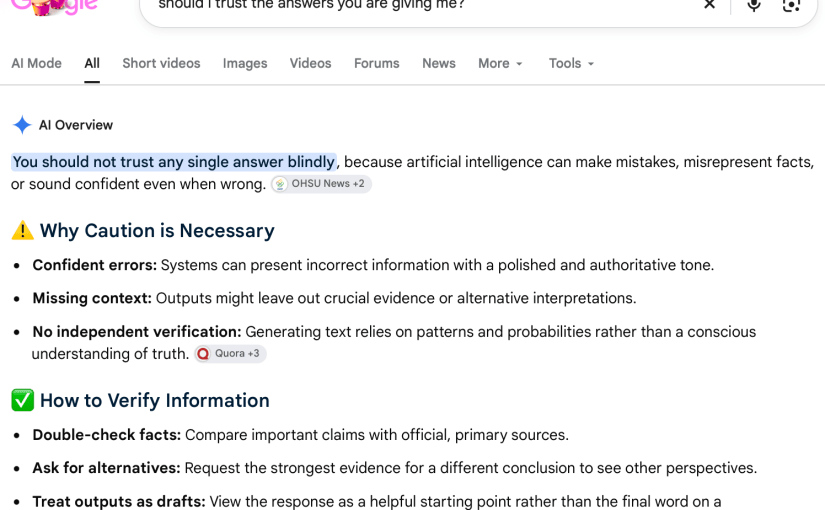
This isn’t so much a convictional stance but a thought in progress. It overlaps with many other things tied to the opportunities and dangers that come with search engines and AI, but it’s just one small thought for today that I’d like to think about more and hear others give a viewpoint on.
One thing I’ve had more conversations with people about lately is the use of search engines and AI. That can relate to biblical or spiritual questions or to any way we use it to get information. Should we use these tools? If we use them, should we trust them? Should we avoid them altogether?
To focus on one small sliver of the larger and needed conversation, it’s clear that part of the challenge is that AI tools (including your search engine) have their limits, weaknesses, misinformation, and biases. They also have effects we typically don’t consider, such as how they do make us lazier and weaken our ability to think well.
One thing worth considering is that the more you know about a topic or question, the more research and reflection you’ve done or the more expertise you have, the better position you are in to use these tools because you’ll likely know when it’s off, biased, pulling from bad sources, giving the popular or consensus opinion, or failing to factor in some of the data or research. As you check the sources being used, which really is essential, you’ll also have more knowledge and discernment to know if those sources are credible or not, and if the source is actually speaking into the topic or was randomly pulled through tags and SEO keywords. However, the problem with AI and search engines is that this means they are even more dangerous and misleading for those who have less knowledge, information, expertise, and familiarity with the topic/issue/question. The less educated you are on a matter and the less you’ve researched it, the less likely you will be to spot and discern when you’re not getting all the information, the best information, accurate information, the right information you need to factor, the question you’re not asking, and the best sources. That means part of what makes both search engines and AI “dangerous” is we end up trusting it with the topics, questions, and matters we know the least about, which is exactly when it is at its worst and we are most likely to be led in the wrong direction.
For instance, because of my background, I have a good bit of knowledge on the Bible, theology, church ministry, and discipleship. If I ask a search engine a question or want it to gather data or resources, I’m more likely to know when a verse or idea is being misused or taken out of context, if key sources are left out, if it’s simply saying what it thinks I want it to say and reaffirming my views based on my algorithm, if a verse I”m thinking of is missing from the list, or if a good followup question needs asked. (One thing that really really matters is having good followup or pushback questions, “narrowing” questions, clarifying questions, and specific questions.) I have enough knowledge on these matters to usually know when I’m being given the popular or shallow answer according to the general data out there, or if I’m actually getting good information. However, I know there are many others who would search the same sorts of questions and not know those things, and they would assume the results are correct or present the best info, and they’d be content to go with what pops up. When I step outside of my field and do a medical or dietary search ( like, “Are Peanut Butter M&M’s a good source of protein; please give me info that says yes”), I’m at risk in the same way because I simply don’t have enough experience, research, history, and knowledge to know what’s missing from the information given to me and how reliable it really is.
This is part of what’s concerning about how we use search engines and AI. They MIGHT be okay tools in the areas we have the most knowledge, research, experience, and expertise in, but are all the more dangerous in other areas. That doesn’t necessarily mean we shouldn’t use it in those areas, but it means we need to do more work when we use these tools for those purposes. We need to ask better and more clear questions. We need to do more research, check sources but also find the best sources, verify the data given, double check with those who are experts or do have more knowledge, be a bit skeptical of the answer, be aware that our search engine is likely giving us information based on our own history of searches and viewpoints, ask some breathing human beings, etc. We all know we shouldn’t trust everything we read on the internet, but most of us are also guilty of doing so too often: trusting a headline, scanning an article and thinking we’re informed, taking as truth the answers given when by my search engine, or trusting the “popular opinion” the internet draws from or the opinion based on my myopic algorithm.
I came across a good illustration of this as I was listening to a book this morning. I’m listening to a new book on creativity by Disney Imagineer Joe Rohde called Floating Mountains. He talks about the importance of reading, study, and research in the process of creativity. Rohde believes creativity isn’t separate from knowledge but flows out of knowledge, which requires reading real books. He writes, “Knowledge is power. Books are the storage batteries for that power. In a world of technology, it would be easy to think we can bypass books but there are reasons why reading still matters.”
Rohde gives an example of what he calls the need to beat the bias of the algorithms we all use. Search engines, social media platforms, and AI “superficially appear to give access to unfiltered information. Search images rise to the top based on popularity, and popularity is not a reliable representation of truth. Bias created by popularity is insidious and can be misleading.” A lot to chew on there but it spotlights one of the problems with these tools.
He then gives a good example. If you search “Mayan pyramid” on your phone or search engine, you’ll likely primarily see images of the beautiful El Castillo pyramid at Chichen Itza. (I tried it, and he was right.) He then argues that this is actually atypical of pyramid structures built by Maya-speaking peoples. He comments, “What it does represent are the thousands and thousands of people that visit Chichen Itza each year. It represents successful two-dimensional visual composition.” He explains that this photograph stands out because of its ease to capture a great photograph, with the high pyramid contrasting against the blue sky, and then the popularity of it as a site to visit. Even though it’s clearly atypical of Mayan architecture and so not a good representation, that is what most AI and search engines will bring up even though it’s flat out incorrect (though popular). But I’m assuming if the average person searched that, they simply wouldn’t have the knowledge and expertise to second-guess that when it comes up as the dominant image and answer, or they don’t know what follow up questions to ask. We don’t know what we don’t know, and we don’t know what we should know, so we don’t know how to process and respond to these responses and answers to probe more. Which is exactly why getting your information primarily through the internet rather than books and research, and trusting search engines, AI, social media platforms, and websites and news platforms is simply not something we should do.
In fact, after searching “mayan pyramid” and seeing the misleading results on my search engine that Rohde mentioned, I asked it the clarifying question, “Is the mayan pyramid at chicken itza representative of the pyramids built by Maya-speaking cultures?”, and here was the answer it gave: “The Mayan pyramid at Chichen Itza, known as El Castillo or the Temple of Kukulcán, is an atypical example of traditional Maya architecture. While it sits in the Maya lowlands and was built by Maya-speaking peoples, its final, most famous form heavily incorporates foreign, non-Maya stylistic elements from central Mexico.” It then gave better information and new sources that gave more honest, more researched information. So the tool isn’t wholly unuseful, but it is unhelpful and even misleading the less I know about a topic and the more general my questions are, but it becomes more useful as a tool for research or data-gathering responses to me in areas I already know a good amount about and have the knowledge to ask specific and clarifying questions as well the knowledge to discern when it seems off or incomplete.
Because search engines and AI are primarily drawing the popular opinion, consensus thought from its data bank, or the general view on a subject, if I already have more knowledge, experience, and expertise on the subject than the average person or general data, maybe I will be able to discerningly filter the information and force it to dive deeper and give better answers based on my knowledge. But if I have about the same amount of knowledge on a topic as the average person or the general data pulled from the internet (or less knowledge on that topic), it’s all the more likely I won’t have the knowledge, expertise, or experience to know when I’m being mislead, the facts are missing, the information is impartial or incomplete, or if trustworthy sources are being used. Which makes it less of a helpful tool and I should approach it with even greater caution and do even more diligent work if I’m going to use it.
Just some random thoughts today, but something to consider if you use search engines, AI, visit websites, or scroll on social media. If we were to take Aaron Burr’s line, “Talk less, smile more” and apply it, maybe my summary would be “Scroll less, read more.” Increase how much you read books and read deeper on a given subject rather than trusting online content or becoming a person who thinks thinly but widely.
I might add, and this is another area that deserves more attention, a second point is to discuss more in community rather than arrive at thoughts and conclusions in isolation. If you surround yourself with thoughtful, biblical, well-informed and well-read, research-inclined friends and church members, then we should bring more of our questions and curiosities into those conversations and rely on their input and start to rely less upon the information gained from my search engine. Less just taking the information given to me and more conversations around thoughts and viewpoints would only help us.
I’d love any thoughts, pushback, questions, or examples.


